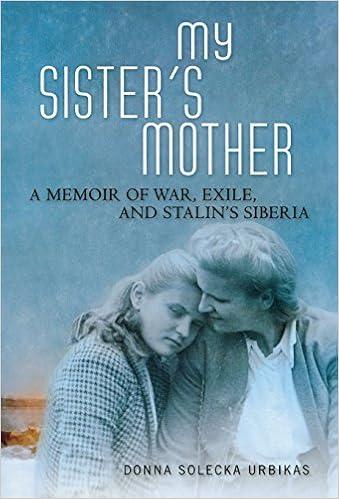
My Sister’s Mother: A Memoir of War, Exile, and Stalin’s Siberia
Reviews (69)

A fantastic story of determination, strong will, and survival in the face of extreme hardship
I just finished reading this book and enjoyed it on so many levels. First there is the story of survival, how a (for all purposes single) mother and young child, through sheer will and determination, suffered and survived the extreme hardships of Stalin's forced labor camp--Poles arrested in 1940 simply for being Polish and forced into hard labor under the extreme hardships of a Siberian prison camp. It's a great story of survival, first in the prison camp, and then on the long, long road to freedom via Persia, India, England, and eventually settling in the United States many years later. It's also a subtle story of love and respect, how two people met in the midst of these extreme hardships and were kind to each other, and how the fates brought them together again, eventually to reunite, wed, and give birth to the author, Donna Solecka Urbikas. It's also a story of understanding, how author Donna Urbikas spent her life trying to understand the foreign-to-her life lived by her mother, half-sister, and father in a land far, far away during a time that is horribly unimaginable, and about all the hardships and tragedies they survived during those long, dark years. And it's also a story about Donna's own life, how she did not want to be like her mother, and yet the best of her mother shines through in her own personal life and struggles. That fierce determination that helped her at that time young mother through those dark years of Siberian exile and the following long road to liberation and freedom are traits that Donna have formed Donna into the determined woman she is today. I think most of us at times, when we're growing up, don't want to be like our parents. But I think we usually are, and it's only later in life that we can appreciate that. Donna tells this part of the story very well, too. This story is wonderfully told, the past interwoven with the present, as Donna works to better understand her mother (and to a lesser extent, her sister and father), and slowly comes to a better understanding of what shaped not only them, but how that experience of growing up in such an environment with such a sad past shaped her and how she deals with her own family. Events from Donna's life with her family are intertwined with the stories her mother told of those dark years in exile, and the result is a story that makes sense, how our past and that of those closest to us shape our own present. I found the move from present to past really enhanced this story. It what I experience at times, sitting around the table, chatting with one of my parents, when all of a sudden some new story about their past surfaces. We are all products of the past of our parents, and this book helps demonstrate that. Next time my folks tell a story, I'll appreciate it all the more--and probably take better notes! I found this book to be a very emotional read, a fantastic story well told, and I highly recommend it.

This story is first a surprisingly touching story of a mother and two daughters; Stalin's Siberia is the near-impossible setting
This book is exceptionally well-written and held my attention, making it a surprising two-day read. Somehow I was expecting a tale of history, more academic in nature, since it's published by a university press. But the core of the book focuses on motherhood, the roots of relationships between a mother and her daughter, and how far a woman is willing to go to survive and protect her child in impossible circumstances. Exile to Siberia is the powerful setting that few outside the Polish community are fully aware of, which adds to the value of this story. The author's mother and her five-year-old daughter were two of hundreds of thousands of Poles forcibly evicted from their homes in February 1940 and then, well, no spoiler alerts here, except that they endure a tortuous journey together. A second key exploration in this book is the author's personal experience of a second-generation survivor of war trauma, as well as being a first-generation immigrant of Polish parents, who can never return to a communist Poland. Then, on top of this, in the second half of the book, the story turned surprisingly personal as she faced many simultaneous trials of being sandwiched between younger children with issues, and aging parents, which is a subject I completely relate to. I suspect I'll be still be thinking about this book in the weeks to come, especially for the first-hand view of deportation to Siberia.

Vivid and moving
My Sister’s Mother is a very moving account of a young Polish mother’s survival in a Soviet labor camp and later in equally perilous refugee camps. The description of the horrific conditions and the struggle to keep herself and her daughter alive was extraordinarily vivid. It was not just the cold and hunger but the filth and the lice everywhere, all intensely portrayed. At the same time it is also the story of the impact of those experiences on her younger daughter growing up as an American. I really liked the way the two stories – the mother’s past and the daughter’s present – were interwoven and alternating until at the end they converged. This memoir not only illuminates a small hidden corner of history but also reminds us all that no matter how difficult the relationship, in the end we cannot help but carry our parents’ lives within us.

Stunning Memoir about the Siberian Deportation and Its Consequences
This stunning, heartfelt memoir looks unflinchingly at the scars borne by one Polish immigrant family as their younger daughter tries to become a normal American girl in Chicago while her mother and sister suffer unimaginable pain from their experiences during the Holocaust years. A gripping study of family dynamics, this is also a must-read for scholars of World War II and the horror perpetrated on civilian populations by the Soviets as well as the Nazis. My Sister’s Mother is Donna Solecka Urbikas’s labor of love, based on carefully recorded recollections in her mother’s own voice and supplemented by precious photographs taken by her father, a camera buff, when little of this history was recorded on film. Since 1989, a welcome rash of memoirs about the experience of Poles during the 1940s has brought to the attention of readers and scholars the central role of Poland in World War II and the susequent battle for domination in Europe known as the Cold War. Perhaps the most obliterated aspect of the horrors of this period in history was the mass deportation of Poles by the Soviets to execution, slave labor, or starvation in Siberia. My Sister’s Mother is an authentic record, written from the heart and powerful in its ability to show how, from war to war to war, the conflicts of the 20th century bleed one into the other and linger in our lives today.

The Refugee Experience Vividly Captured
This book is about the refugee experience of the author's mother, sister and father. It will deepen the reader's understanding of the refugee experience, which is so relevant today. What sets this book apart from other refugee tales is how this refugee experience affects the American-raised child of the refugees (the author). I appreciated the structure of the story, with the chapters going back and forth in time. One chapter is on their life in America, then the next chapter goes back to war-torn Europe. It's an effective tool that maintains the reader's interest and connects the two parts of the story.The author's descriptions of her mother's life experience are exceptionally vivid. I had no idea that any refugees traveled so far from Poland to various places in the vast former Soviet Union, to Iran, to India, to England and finally finding a home in the United States. It's an amazing story of survival.

Memorable Story of War, courage, and Love
I was very excited to read this book since I am researching my Polish family. I know I have relatives there, I just have to find them! This book gave me great insight into what it was like to live in Poland during this terrible time in history. Life, here, was not for the feint of heart and Donna's mother was one strong, courageous woman. The fact that she was able to save not only herself but her daughter, Donna's sister, was a miraculous feat. Donna's relationship with her mother and sister was hampered by the fact that she did not understand the history behind their relationship and difficult journey. As this story unravels it was easier for Donna to understand and I think to "like" her mother. Her love and admiration for her mother also grew and changed over the course of the story. Anyone who is interested in life during World War II or non fictions stories about self realization will enjoy this book. It is not a difficult read and will encourage the reader to reevaluate certain relationships and views on their private lives. Thank you, Donna, for sharing your family's story with us.

Polish citizens trapped in soviet gulag
I wanted to love this book but I must say I struggled to finish the book. The subject matter was interesting (polish citzens trapped in soviet gulags) but I didn’t like the book’s style of alternating modern/ww2 chapters. I found the style to be jarring. But I would like to say how much i cheered on mira and her mother to survive such a shocking experience

Captivating from page one
Donna's book captivated me from the first page. I knew of the Polish history in a general way, but her descriptions paint the picture on a visual and emotional level that us unforgettable. I'm particularly enjoyed the honesty and vulnerability in presenting the relationships between each daughter and their mother, the two sisters, the father. If anyone wondered what a sentence of "hard labor in Siberia" really meant, they would learn in detail, here. They would be inspired by the stories of seemingly insurmountable hardships, persistence and survival. A great read.

The story was one that needed to be told. I am a relative of Jozef Czapski , he is was my second cousin on my father's side. The ad we spell in America Chubski. Anyway I have so many stories I have missed out on because my father never spoke of his time during WW2. He never wanted to speak of things he saw. I do know he was an interpreter for the Polish.
All 4 of my grandparents came from Poland.,. I am proud to be Polish and this story helped me to understand what my family went through. It is sad that these stories are still not known. Donna, I c an not thank you enough for taking the time even through all the speed bumps in your life. You are an ama,I h person and one who shows the strengths one has to get through life. You make people aware of no matter where Polish people are in the world the we are strong and fighters and we will prevail. Again thank you or better yet dziekuje! Dana Marie Chubski Cameron FYI for my first name from the Ray Henry Polka label

I was riveted to this book
Bravo!! A great summer read! I was so immersed that I forgot I was in transit to, in, and from Brazil at the time and rather imagined that I was in Poland, Siberia, Chicago and the idyllic farm in Wisconsin. Best page turner I have read in a long time. I cannot imagine two generations of a family being so different yet so intertwined. In the end it is all about family! Every American should read this unbelievable and true story about two generations in the 20th century forever changed by evils and sometimes heroics of the two world wars and their aftermath. The book shows the "rest of the story" of the toxic effects of demonic politics that we all need to be especially careful of now in the returning nationalism around the world.
Comments
Post a Comment